Understanding the different types of verbs is crucial to mastering the nuances of the English language. In this post, we’ll explorestative verbs—a unique category of verbs that describe states of being, emotions, and perceptions rather than actions. Stative verbs are essential in expressing conditions that are generally consistent and unchanging.
To help you grasp this concept more effectively, I’ve created a concise PowerPoint presentation that covers the definition, usage, and examples of stative verbs. Whether you’re a student looking to enhance your grammar skills or simply curious about the intricacies of language, this presentation will provide you with valuable insights.
Check out the slides below to dive deeper into the world of stative verbs!
A proverbis a short sentence that people often quote, which gives advice or tells you something about life. (Απόφθεγμαονομάζεται μία σύντομη πρόταση ή φράση, η οποία περιέχει συμβουλές ή κρίσεις από πρόσωπα αδιαμφισβήτητου κύρους και θεωρείται μία αιώνια αλήθεια.)
The study of Proverbs is called Paremiologyand we can trace the origin of proverbs as far as the times of the great Philosopher Aristotle. But the authors of most of the proverbs are still unknown.
Today's proverb is " A bad workman always blames his tools."
But how has this proverb come about?
Kumar and Ravi were two farmers who were neighbors. Both owned a pair of oxen (singular:ox/plural:oxen - βόδι/βόδια)each with which they plowed (άροτρο / οργώνω) their land. Kumar worked hard all day long in order to get a good yield (σοδειά / αποδίδω/ λυγίζω) and looked after his oxen very well since he knew that they were very important for his farming activity.
Ravi on the other hand was very lazy and a miser (τσιγκούνης / παραδόπιστος)who never fed his oxen properly but extracted maximum work from them and kept complaining that they were not doing a good job.
As a true friend Kumar advised and pointed out to Ravi that it was cruel to ill-treat (κακομεταχειρίζομαι) the animals which were helping him make a living. Ravi paid little heed to Kumar’s words. He soon bought a tractor to plow his land and chased the oxen away, since he no longer needed them. Taking pity on the poor animals Kumar took them under his wing (παίρνω κάτω απο την εποπτεία μου) although he could ill-afford to maintain them.
The monsoon (μουσώνας) soon arrived and it was time for cultivation. Kumar’s land was well plowed and ready for cultivation – thanks to his oxen. Ravi in his miserly fashion had not maintained his tractor well and it kept giving him trouble. As a result, he could not get his land ready for cultivation on time. He lamented and blamed it all on bad luck not realizing that it was he who was responsible for his miserable state. Ravi not only lost out on a good yield by his laziness but also spent more money than required to repair his tractor due to poor maintenance.
Despite having better equipment, Ravi was unable to get the best results, whereas Kumar was a good workman and hence (επομένως) was able to succeed with the limited resources that he had.
In continuation of my previous post regarding the ECPE Speaking part, I have created a table of the most common phrases used in prompts (specifically regarding people and venues):
Following below, I am about to present some original work, created by a star student of mine. It's her first year preparing for level B2 examinations.
The scope was for her to create an opinion essay. Following the rules and structures dictated by the Examination for the Certificate of Competency in English (ECCE).
Her task was as follows:
Based on the above rubric and task at hand, she proceeded creating (a) a plan of the opinion essay and (b) used prompts that were given prior to the task and finally (b) executed the essay.
There are many ways to incorporate the use of the word "like" in English. Lets have a look:
A/A
Use
Meaning
Example
1
Like +
ing or infintive
It shows a preference
in something
a)I like going to the cinema
b)I liketo see all the latest movies
(!) When we use like with –ing,
we express a general preference.
When we use it with an infinitive
we express an idea that we have or
a regular action.
2
Would like
We use it to make
polite offers
Would you like to have lunch next week?
3
Like used as “as if”
= “λες και”
It is used orally
and informally.
a)I feel like
I am a princess.
b)It was like
I was back in the sixties.
4
Like
= “Σαν”
= “πώς είναι ο χαρακτήρας κάποιου”
= “ τυπικό
παράδειγμα”
It is used as “similar/typical”
a)Like me, you are probably a bit shocked.
b)What is Harry like?
c)You look like
you need to sit down.
d)It is just like
him to be late.
5
Feel like
It means I have a
desire (πόθο) to do
something
I feel like going out for a meal.
(!) Like can be used with the adverbs quite / rather (αρκετά).
A) It is quitelike the old times.
B) It is ratherlike it was before
we had computers.
Useful
phrases with “ like “
A/A
Phrase
Meaning
Example
1
Come when you like
Είσαι ευπρόσδεκτος οποτεδήποτε.
You are always welcome. Come when you like.
2
Do as you like
Κάνε ότι νομίζεις
It is entirely your choice. Do as you like.
3
If you like
Εάν θες.
We could go together, if you like.
4
Like this
Με αυτόν τον τρόπο
You out the paper in here like this.
5
Eat like a horse
Τρώω πολύ
Kate eats like a horse but she seems to never
put on weight.
6
Feel like a million
Αισθάνομαι όμορφα ψυχολογικά και εξωτερικά.
I have bought a new suit for work. I feel
like a million.
7
Go like clockwork
Όλα λειτουργούν ρολόι
The launch of the new product went like
clockwork.
8
Like a bat out of hell
μανιασμένα
He drove like a bat out of hell, I was scared.
9
Like a fish out of water
Αισθάνομαι έξω από τα νερά μου
He knows a lot about
accounting but he is like a fish out of water in marketing.
10
Sells like hot cakes
Μοσχοπουλάει
The new iphone sells
like hot cakes.
11
Out like a light
Σβήνω από την κούραση
He was so tired that
he went out like a light when he lay on the sofa.
12
Watch like a hawk (γεράκι)
Επιβλέπω κάποιον έντονα
During the test, the
examiner watched the candidates like a hawk to prevent any cheating.
13
Spreads like wild fire
Κάτι εξαπλώνεται σαν την φωτιά
Reports of their
argument spread like wild fire through the company.
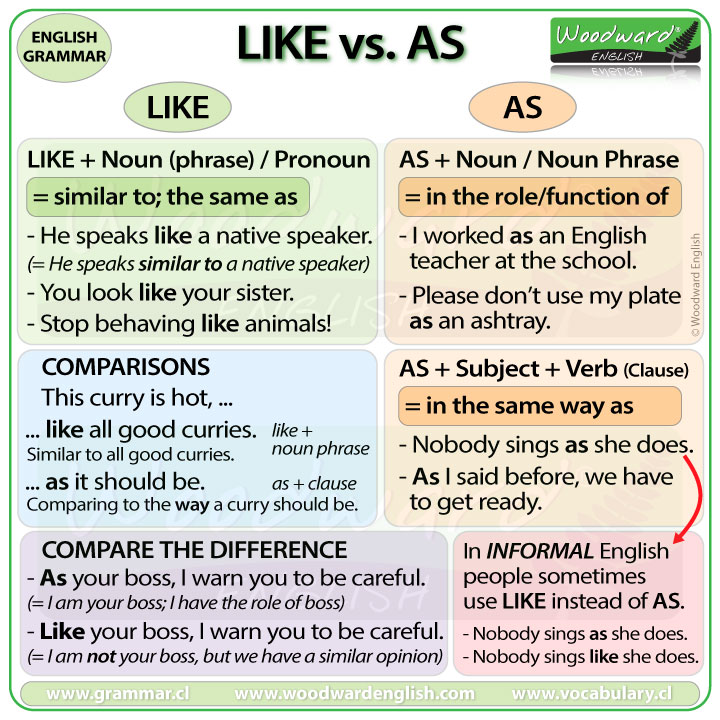
Difference between “As” and “Like”
Εννοιολογικά: Η διαφορά μεταξύ των δύο έγκειται στο γεγονός ότι με
την χρήση του “as” υπογραμμίζουμε την λειτουργικότητα / ιδιότητα του ατόμου ή του αντικειμένου ή
δηλώνουμε ότι κάτι γίνεται με τον ίδιο τρόπο, ενώ με την
χρήση του “like” υπογραμμίζουμε μόνο την ομοιότητα.
e.g. He
works as (in the role
of/ μετηνιδιότητα) a bank teller.
e.g. As I said before, we have
to get ready.
e.g. He
speaks like (similar to/σαν) a native speaker.
Συντακτικά:
Όταν θέλουμε να συγκρίνουμε τότε χρησιμοποιούμε το “as” με δευτερεύουσα
πρόταση (υποκείμενο+ρήμα+αντικείμενο) ενώ το “like” με ουσιαστικοποιημένη πρόταση.
e.g. Your
outfit for tonight is beautiful as
it should be.
e.g. My son
gets straight As like all good students.
Practise your understanding of the use of "like vs as" completing exercises in the following links: